Showing posts with label Christmas. Show all posts

Saturday, December 21, 2024

The Science of Christmas


THE SCIENCE OF CHRISTMAS

 The Unique Characteristics of Reindeer


Why did Santa choose Rudolph to lead the reindeer? Of course, it was because his nose is red and red has a longer wavelength compared to other visible light colors. This means red light is less scattered by specks in the atmosphere making it easier to be seen far away, even in snowy or foggy weather. It also helps the other reindeer to follow him.

 A species of reindeer, Rangifer tarandus, that lives primarily in arctic areas such as Greenland, Scandinavia, and Alaska,  actually has a red nose due to many blood vessels bundled close together. These vessels help regulate their body temperature in extreme environments and keep the nose and brain from freezing.


But why reindeer? These animals have physical attributes that help with travel. Their superior vision helps them detect subtle differences in terrain whether snow, ice, mud, or sand and splayed hooves help distribute their weight for better traction as well as preventing sinking.

 Scent markers help them navigate and find their way back to familiar areas. Their dense fur keeps them warm in freezing temperatures, which is essential for maintaining energy levels and overall mobility. 

While real reindeer don't fly, it is fun to explore how natural atmospheric phenomena could make flying possible. Fast-flowing atmospheric air currents can carry objects from one location to another and thermals, rising air currents, are known to lift gliders and drones. Research has not discovered the rivers of thermals that may exist throughout the world.


 The Curling Ribbon Phenomenon

Image by Mari Loli from Pixabay

 Those beautifully wrapped gifts under the Christmas tree are as anticipated by big kids as little ones. The paper and ribbons are a wide variety of styles and materials. Some of the best ribbons are the twisted and looping curls in the long thin ribbons.

Why does curling ribbon curl? You will note that the ribbons that curl are generally metallic or heavy paper and that fabric ribbons will not work. The twisting is due to non-uniform stress during peeling. When you pass the scissors, or other implement, over the ribbon, one side of the ribbon, even as thin as it is, is stretched more than the other. Hence, the ribbon twists due to the distortion of the material. In other words, if you had a material made of two layers, joined together, and one side suddenly became longer than the other, the material would bend. This is called "non-uniform" stress.

Carol Kagan


Just go with the magic.

˜˜

Interested in herbs? Looking for a gift?
Perfect for a hostess gift, or birthday or housewarming.

 Check out the Herb Sampler on this Blog  

The Second Edition Herb Sampler (2019) is available through Amazon. 

Just click this link to find it.


Friday, December 17, 2021

The Heirloom Gardener - Wreaths


Wreaths (from the Middle English wrethe, a twisted garland or ring of leaves and flowers) have been used ceremonially...

Posted by The Heirloom Gardener - John Forti on Sunday, December 5, 2021

Thursday, December 16, 2021

Mistletoe (Phoradendron)

Eastern Mistletoe- Phoradendron leucarpum in Northeast Texas
(Loadmaster David R. Tribble)

There are 1,300 mistletoe species worldwide.with 30 in the continental US and Canada  and 6 others in Hawaii.

All mistletoes grow as parasites on tree and shrub branches. The genus name of North America’s oak mistletoe, the most common in the eastern US—is Phoradendron, Greek for “tree thief.”

Not very romantic! Ancient Anglo-Saxons noticed that mistletoe often grows where birds leave droppings, which is how mistletoe got its name: In Anglo-Saxon, “mistel” means “dung” and “tan” means “twig,” hence, “dung-on-a-twig.”

Photo: Nellie Benson,
Wikimedia Commons
Because mistletoe could blossom even during the coldest winter it is associated with fertility and vitality. The custom of kissing under the mistletoe started in 18th-century England.

The Romans associated mistletoe with peace, love and understanding and hung it over doorways to protect the household.

The mistletoe’s white berries are toxic to humans but are favored during autumn and winter by mammals from deer to chipmunks and bird such as robins, chickadees, bluebirds and mourning doves.


Brown-Honeyeater
feeding-on-mistletoe


Three U.S. butterflies depend on mistletoe for survival: the great purple hairstreak, the thicket hairstreak and the Johnson’s hairstreak. These butterflies lay eggs on mistletoe, the caterpillars  eat the leaves, and the adults feed on mistletoe nectar as do some native bees.


CKagan, Master Gardener

*   *   *

HOLIDAY SPECIAL Price reduction.

Interested in herbs?
 
Looking for Holiday Gifts?
 Check out the Herb Sampler on this Blog  

The Second Edition Herb Sampler (2019) is available through Amazon.


Wednesday, December 23, 2020

Twas the Night Before Christmas for Gardeners


‘T was the Night Before Christmas for Gardeners


‘T was the night before Christmas, and all through the yard,

The branches were bare and the ground frozen hard.

The roses were dormant and mulched all around

To protect them from damage if frost heaves the ground.


The perennials were nestled all snug in their beds,

While visions of fertilizer danced in their heads;

The newly planted shrubs had been soaked by a hose,

To settle their roots for a long winter’s doze.


And out on the lawn the new fallen snow

Protected the roots of the grasses below;

When, what to my wondering eyes should appear,

But a truck full of gifts of gardening gear.


St. Nick was the driver a jolly old elf,

And he winked as he said, “I’m a gardener myself.

I’ve brought new seeds and light systems, too,

Give them a try and see how they do.


“To eliminate weeding, I brought bags of mulch,

To attract the pollinators I have flowers for best results.

To add to your joy, I’ve plenty of herbs

And ornamental grasses for your hell strip curb.


“For seed planting days, I’ve a trowel and a dibble,

And a roll of wire mesh if the rabbits should nibble.

I have the latest books, plus some gadgets you’ll love;

Plant stakes and frames, and waterproof gloves.


“Here are sharp shears and a new compost pit

And, for pH detecting, a soil testing kit.

With these colorful flagstones, lay a new garden path.

For the view from your window, a bird feed and bath.


“And last but not least, some well-rotted manure,

A green garden year-round, these gifts will ensure.”

Then, jolly St. Nick having emptied his load,

Started his truck and took on the road.


And I heard him exclaim through the motor’s loud hum,

“Merry Christmas to all, and to all a Green Thumb!”


Taken from PegPlant, December 2016


Saturday, December 19, 2020

The 2020 Christmas Tree


This year’s Christmas tree is quite different than last year’s tree as we are cocooning at home this year. Perhaps its simplicity is due to being lazy and not wanting to decorate a 10-foot tree when no one is coming to visit. Or the opportunity to do some holiday crafting of a different nature. Or maybe because I have collected some things on my strolls around the neighborhood.

Perhaps my inspiration came from a holiday project sponsored by Grove Family Library a few years back. 

We assembled a tree from cut greens tucked into a chicken wire cone. I brought nature-inspired items to decorate it. I made garland with hemlock cones. They are quite small. The feathers are pheasant from a hunter friend. There are also pine cones and green berries from some plant, sweet gum seed pods and a craft store bird's nest. I made a star from twigs and birch tree bark. I believe the red berry garland is from a pyracantha bush.


Decorations on our tree include a cornhusk doll made during a Master Gardener workshop with Charles White a few years back so it is a fond memory. A few feathers from a Cardinal were added. I have since made cornhusk dolls with my granddaughter. We even figured out how to make the boys and men. There was a request to make more but I ran out of cornhusks.


Acorns  are from wandering the neighborhood as are the feathers - bluejays, cardinals, doves, goldfinches and a few others. The milkweed pods are from the garden, dried hydrangea blooms and barberry twigs from a neighbor’s yard. The hemlock cones (so little) are from a tree our neighbor had to have removed because of wooly adelgid problems.


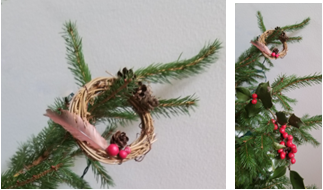
Little wreaths from the craft store were the bases for hemlock cones and acorns, plus a feather for accent. The holly sprigs were, again, from a neighbor's yard on a non-snowy day. 

The wooden "snowflake" came from a craft fair and was handmade using walnut, ash, cherry,  poplar and mahogany. Several were purchased as gifts. On a trip to Japan, students were asked to bring a few small gifts in case they needed to thank someone. A group got lost and a stranger led them back to their hostel. He received one of these in a small, tied box as a thank you. I am sure he was pleased to open the box and see one of these with a note about the wood.


And there is even a few Monarch wings that were found here and there. 

Wishing you a holiday season that brings you happy memories and thoughts of the great celebrations coming in the Aftertime.


Thursday, December 17, 2020

Snow on the Mountain Cookies


Since my son was young we have made these cookies at Christmas time. I hope I will be able to make them with my grandkids next year. They are also known as Chocolate Crinkle Cookies. This is from the back of a Nestle's mint chocolate chip package many years ago.

1 ½ C chocolate morsels- 10 oz. (mint if you can find them) divided
6 Tbsp of softened butter (3/4 stick)
1 C sugar
2 eggs
1 tsp vanilla
1 tsp peppermint extract
1 ½ C flour
1 ½ tsp baking POWDER
1 tsp salt
10 X powdered sugar

Combine flour, baking powder and salt in a bowl.

Melt 1 C of the chocolate chips. In microwave- 1 minute on high. Stir. Heat in 30 sec. increments until melted.

(You can use hand mixer). In a large bowl, cream butter and sugar. Add melted chocolate, vanilla, and peppermint. Mix well. Add eggs last so hot melted chocolate does not “cook” them.

By hand, mix in flour, baking powder and salt. Add in the ½ C of chocolate chips. Mix well.

Wrap in wax paper or plastic wrap and put in freezer for 20 minutes.

Put 10 X sugar in a bowl. Make 1 Tbsp balls of the dough and roll in 10 x sugar. Put on Ungreased cookie sheet or lined with parchment paper.

Bake 8-10 minutes. Leave on cookie sheet to cool. They will seem uncooked when you remove them but will end up chewy when left to cool on the cookie sheet. Sift or sprinkle 10x sugar on warm cookies, if desired.

Makes about 6 dozen small cookies.

Dough can be frozen for later use. Roll into balls and freeze separately on a cookie sheet or pan. Put in a freezer bag once frozen. Roll in 10X sugar after thawing and before baking.

Photo from Amanda's Cookin' (https://amandascookin.com/chocolate-crinkle-cookies/)


I Write: What Carries Us

At our monthly Writing is Fun meetings we decide a prompt for writing for the next meeting. Length is set at 2 pages so we can read them at ...