Tuesday, October 19, 2021

It's Garlic Planting Time


 (From my Gardening Column in the Franklin County Free Press)

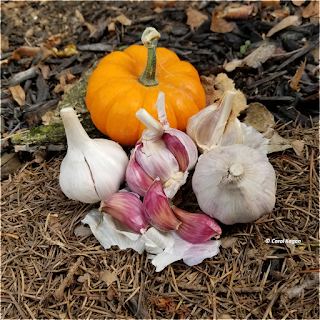
It’s garlic planting time - now until early November, before a local freeze. One bulb of garlic with 8 to 10 cloves will give you 8 to 10 bulbs next year. A fine return for your patience as garlic has a long growing season. Garlic takes 8 to 9 months to harvest so fall plantings won’t be ready until May or June next year. Fall is the best time to plant as it allows the roots to develop. You will be planting garlic cloves, the individual pieces from the garlic bulb.

There are two types of garlic – softneck and hardneck – the neck referring to the stem. Softneck types have a long shelf life, mild flavor, and their leafy stem makes them easy to braid. They are the ones most often stocked by grocery stores. Hardneck are recommended by Penn State for southern areas in the state.

1-Buy your bulbs from your local nursery, garden center, or mail order from catalogues. Remember when you buy that there are from 8 to 12 cloves per bulb but you will want to plant only the biggest.


2-Start in a small area with well-drained soil and a minimum of 6 hours of sun. It is important to prepare for future replanting as it needs at least two years or more to allow the soil to recover. Horticulturist Jessica Walliser shows how it might be grown in pots.

3-You will need to break the bulbs to get the cloves to plant. Don’t do this more than a day before planting as the root end will dry out making it have to get established. Sort the cloves keeping the biggest to plant.

4-Plant upright with the root nodule down about 2-4” into the soil, spacing them 4-6” apart. Leave 6” between rows.

5-Water them well for 3-4 days then mulch with 2-4” of straw or shredded leaves. For proper bulb formation, water weekly as needed and side dress with nitrogen rich fertilizers until the flower stalks (scapes) appear. Allow the soil to dry before you harvest. Check out this information from the  Allegheny Master Gardener program. 

6-Use a garden fork to lift a few bulbs to see if they are mature.


7-After harvesting, allow them to dry and harden in a shady, well-ventilated, shaded area for a few weeks. Brush away the dirt and trim the roots and tops within an inch of the bulb.

CKagan, Master Gardener

*     *     *

Interested in herbs? Looking for Holiday Gifts?
 Check out the Herb Sampler on this Blog  

The Second Edition Herb Sampler (2019) is available through Amazon.


Saturday, October 16, 2021

An Intelligent Murder of Crows

 BIRDS WITH AN ATTITUDE

It was very late. I couldn't get to sleep and began cruising COMCAST for something to watch and found a PBS Nature show, A Murder of Crows. I learned some fascinating things.

New research has shown that crows can make and use tools, can recognize 250 distinct calls, and not only can recognize human faces but can pass down, through generations, that recognition.

Crows are social birds that mate for life and raise their young for up to five years. And they learn from each other’s misfortunes. When one is killed in a farmer’s field, it’s not uncommon for them to change entire migratory patterns so that no crows fly over that field for as long as two years.

CROWS MAKE AND USE TOOLS: For example, they use twigs to pry insects from wood or from inside long slender flowers. Crows are shown (in the program) using twigs to obtain other twigs that would allow them to obtain food - sequential tool use. Using tools to act on non-food objects – for example, to make or retrieve other tools – is considered to be a hallmark of human intelligence.

Crow using a stick to get a longer stick to get some food

CROWS HAVE OVER 250 CALLS: Calls are complex and vary by species and also regionally, sort of crow dialects. Not only the call but the tone and level of sound change the meaning of vocalizations – loud when defending territory or hungry and quiet, almost purring, to show affection. Distress calls bring other crows to their aid, as crows will defend other crows not known to them.
Univ. of Seattle researchers don masks to test recognition

CROWS KNOW  WHO YOU ARE: Crows recognize individual human faces, and hold grudges against people who have been mean to them in the past. They have the ability to recognize individual human faces and pick them out of a crowd up to two years later. If a "dangerous face" is recognized by a crow, a call of warning is sent out among the crows. In a generation later,  the same face sends out caws of warning. Univ. of Washington researchers used masks in experiments that revealed that crows do not forget.

*     *     *

Interested herbs? Looking for Gifts? Check out the Herb Sampler on this Blog  

The Second Edition Herb Sampler (2019) is available through Amazon.


Sunday, October 10, 2021

Plan Now for Spring Color

From Franklin County, PA Master Gardener Facebook Notes

It’s hard to imagine next spring but try to remember the one earlier this year. Arching forsythia branches covered with yellow flowers, full blooms of mountain laurel, chenille-like branches of flowers on the red bud trees and sweet smelling lilacs. But the first blooms foretelling spring are the blooms of bulbs - tiny snowdrops (Galanthus) and the bright yellows and purples of snow crocus (Crocus chrysanthus) here and there.

It’s time to plan your spring colors and the best bets for bright colors and interesting shapes are bulbs. Planted in the fall they will burst into color just when winter is beginning to fade.

Optimum planting time for spring flowers falls between Sept. 15 and Nov. 30 in Pennsylvania. "It’s easy to plant spring flowers, and …they last for years,” said Jim Sellmer, professor of horticulture in Penn State’s College of Agricultural Sciences. As long as the ground is still soft enough to dig in, bulbs can be planted anytime in the fall.

Look over your garden and landscape for areas that will be bare in spring or areas that can use a pop of color. Don’t overlook shady areas in the fall. Once the leaves are off the trees they may be a sunny space in the spring. Remember that once the blooms have faded the foliage will still be standing. Select a spot where mid- to late spring plants can camouflage the foliage as it begins to fade.

Snow crocus (Crocus chrysanthus)
As always, consider whether you will need a soil test for areas where you are going to plant. Your county Extension Office can provide a soil test kit. Robert Berghage, associate professor of horticulture in Penn State’s College of Agricultural Sciences, provided information about soil needs for bulbs in a November 2000 article.

He noted that bulbs “need good drainage and a high amount of organic matter, so if your soil is mostly sand or clay, mix in peat moss or compost until organic matter is about 25 percent of volume.”

Both Sellmer and Berghage suggest using hardware cloth (chicken wire) when planting if rodents such as chipmunks and squirrels are a problem. You can surround the bulbs with a cage or spread the wire over the top of the soil and cover with mulch.

Spring-flowering bulbs are available from garden centers and catalogs from August to October. "They're easy to plant and live for years," said Berghage. "Best of all, they start brightening the landscape while it's still late winter."

The flowers of bulbs with their wide variety of bloom times can provide a continuous show of color from February through early summer. Early bloomers are Galanthus, or snow drops, which show up in late January. A variety of crocuses start to appear in February and include large flowered Dutch crocuses which can be seen with the star-shaped Glory of the Snow (Chionodoxa) and the deep blue flowered Squill (Scilla).

In March and April look for Grecian windflowers (Anemone blanda) which look a bit like asters and come in purple, pink or white colors. A wide swath of grape hyacinth (Muscari) in dark or light blue colors can resemble a small streamlet and can highlight along a pathway or down a sloped area. Another favorite is Dwarf Iris (Iris reticulate), a 4-6” tall plant that blooms in early spring. Consider planting Narcissus 'Tete-a-Tete" (Cyclamineus daffodil) dwarf daffodils, too.

Tete-a-Tete daffodils


There are many different types of tulips available from tall to short, fringed and cupped, peony-flowering and double-flowering. They are available in almost every color you can image, even striped. Although called a Checkered Tulip the Fritillaria meleagris is a most unusual flower with checkered petals.

Once the flowers bloom, Sellner notes, “It is important to let the foliage die completely before you remove it so that it can gather nutrients for growth during the next season.” He notes that once they have been planted correctly they don’t require much attention.

Photos: Carol Kagan

~ Carol Kagan, Franklin County Master Gardener

**********

Are you interested herbs? Check out the Herb Sampler on this Blog  

The Second Edition Herb Sampler (2019) is available through Amazon.


Sunday, September 5, 2021

Frost, Freeze and Green Tomatoes


From Franklin County, PA Master Gardener Facebook Notes (October 2013)

We are fast approaching the last frost free date of October 15 in Franklin County and many home gardeners, eager to either have homegrown tomatoes for Thanksgiving or loath to discard any possible foodstuff, are looking at their green tomatoes.

FROST VS. FREEZE

Frost,“ killing frost,” freeze warnings, a “killing freeze” - what is the difference? In casual conversation the terms frost and freeze are often interchangeable but there is a very real difference. Frost and freeze are two distinct phenomena. These terms take on significance when they are associated with the growing season.

FROST

According to the National Oceanic and Atmospheric Administration (NOAA), frost is the formation of thin ice crystals on the ground or other surfaces in the form of scales, needles, feathers, or fans. Frost develops under conditions similar to dew, except the temperatures of the Earth's surface and earthbound objects falls below 32°F. A frost advisory is issued when widespread frost formation is expected over an extensive area. Surface temperatures are usually in the mid-30’s. If a frost period is sufficiently severe to end the growing season (or delay its beginning), it is commonly referred to as a "killing frost."


Dr. Katharine B. Perry, North Carolina Extension Service, has compared frost and freeze conditions for protection of horticultural crops noting frost and freeze protection methods are based on preventing or replacing radiant heat loss.

Because frost is primarily an event that occurs as the result of radiational cooling - heat loss at night - it frequently occurs with a thermometer temperature in the mid-30’s. A radiation frost happens when a clear sky and calm winds (less than 5 mph) allow an inversion to develop. An inversion occurs when the heat radiating from the earth rises and causes the cooler air above to be pushed down, and temperatures near the surface drop below freezing.

Covering plants before the sun sets may be protection from frost as this can help retain heat near the plants.

 FREEZE

According to NOAA, a freeze is when the surface air temperature is expected to be 32° F or below over a widespread area for a significant period of time. Use of the term is usually restricted to advective situations or to occasions when wind or other conditions prevent frost.

Dr. Perry explains than an advective, or windborne, freeze occurs when a cold air mass moves into an area bringing freezing temperatures. Wind speeds are usually above 5 mph and clouds may be present. Attempts to protect plants are very limited under these conditions.

A "killing freeze" may be used during the growing season when the temperature is expected to be low enough for a sufficient duration to kill all but the hardiest herbaceous crops.

According to NOAA, freeze warning are issued during the growing season when surface temperatures are expected to drop below freezing over a large area for an extended period of time, regardless whether or not frost develops.

GREEN TOMATOES

We are closing in on the first average frost. (Check the date for your area.) Since it takes about six weeks for a tomato to go from flower blossom to ripe fruit, you should have pruned or pinched back your tomato plants in early-to-mid-September (cutting the growing tip off all the vines and any new blossoms to redirect the plant’s energy toward ripening up the existing fruit).

Oops! Okay, you were enjoying the weather and forgot. Now what? There's always fried green tomatoes or you can store them to ripen up later.

Kansas State also suggests roasting them for eating warm or cold, using in side dishes or freezing in small batches to use throughout the winter.

HARVEST AND STORE TO RIPEN

Pick and store your mature green tomatoes and let them ripen up on counter top or windowsill but not in the refrigerator. Ron Wolford, University of Illinois Extension horticulturist, notes that green tomatoes can be harvested before a predicted frost.

“You can tell when a tomato is nearing maturity by its light green, almost translucent, appearance,” according to Barb Fick, horticulturist with the Oregon State University Extension Service. “Tomatoes that are not in this 'mature green' stage won't ripen.”

Kansas State Extension Master Gardeners note that "not all green tomatoes will ripen off the vine. They must have reached a "mature green stage." Look for full-sized tomatoes with a white, star-shaped zone on the bottom end of the green fruit. Also, on maturing green tomatoes, skin at the blossom end may be beginning to change color from green to pink or red." Use immature green tomatoes in recipes such as salsas or fried.

Ron Wolford recommends removing the stems, washing and drying the fruit. Wrap each tomato in newspaper and place them in a single layer on a shelf or in a box. You can also put them in deep straw or just lay them in a box so that they are not touching. Check tomatoes every few days and discard any that show signs of rot.

Tomatoes will ripen satisfactorily in the dark, according to Fick, and sunlight is not needed; however, temperature is important. Storage temperature should range from 60 to 70 degrees. They will ripen over a period of three to four weeks.

Picking and storing the mature green tomatoes in mid-October means there's a good chance you can have some tasty, home-grown tomatoes for the Thanksgiving celebration.

CKagan, Master Gardener

**********

Interested in herbs? Looking for Gardening Gifts?

 Check out the Herb Sampler  description on this Blog  

SPECIAL Price reduction on Amazon here

The Second Edition Herb Sampler (2019) is available through Amazon. 


Saturday, September 4, 2021

Look Out for Jumping Earthworms!


From the Penn State Extension Article (August, 2018) by Nancy Knauss

Asian jumping worms are a relatively new invasive species but they are rapidly spreading across the United States. They can be found in the Southeast, along the Eastern Seaboard, and in mid-Atlantic, Midwest, and some Northwestern states.

There are still native species of earthworms in a few areas of North America, but in states where glaciation occurred the native species were wiped out. Forests developed without them, but in time European earthworms appeared and began to burrow through the soil. As the tunnels were created, the earthworms mixed soil components and improved air and water movement. Unfortunately, European nightcrawlers are now being displaced by the destructive Asian jumping worms.

These invasive worms are members of the genus Amynthas and live in the organic matter or the topmost layer of soil. This upper layer of organic matter protects the soil from erosion. It is in this duff layer of the forest floor where many of the tree roots establish and wildflowers grow. Asian jumping worms are ravenous feeders and they quickly consume the organic matter and degrade the soil. Nutrients from their castings are rapidly released with a small amount actually reaching the roots of plants. During heavy rainstorms, the nutrients are quickly lost and the soil may be unable to support plant growth. Where there was once lush vegetation and wildflowers, there is only bare soil. When such a disturbance happens, it provides an opportunity for an invasive plant species such as garlic mustard or stilt grass to move in. The structure of the soil is also damaged and often there will be voids under tree roots that are near the surface of the soil.

Asian jumping worms are an annual species—the adults die after the first freeze. The cocoons, which are about the size of a mustard seed, will survive the winter and hatch in mid-April after temperatures reach 50°F for a consistent period. One worm can produce many cocoons without mating. While the cocoons can survive the winter temperatures, the hatchlings cannot survive freezing temperatures.

Worm hatchlings (PSE MG Program)

How do you know if you have Asian earthworms?

One telltale sign of an infestation is a very uniform, granular soil created from worm castings, the nutrient-rich soil that the worms leave behind. The texture of this soil is often compared to coffee grounds.

When you scratch the top layer of soil, you will see the worms thrashing about with an erratic, snakelike movement. These worms, which can reach 6 inches in length, are much more active than European nightcrawlers.

If you examine a worm close-up, you will notice the prominent band around the body of the worm called the clitellum, where cocoons are produced. On a jumping worm, the band completely encircles the body, is milky white to light gray, and is flush with the body. On European nightcrawlers, the clitellum is raised and reddish-brown color and does not wrap entirely around the body

What can you do to prevent jumping worms from invading our forest and landscapes?

It is very difficult to remove an invasive species once it is well established in an ecosystem, so the focus must be on preventing the spread of Asian earthworms. The cocoons, which are very small and difficult to see, can be easily introduced to your garden in compost, bark, or leaf mulch, or when swapping plants with friends.

Consider reducing the amount of organic matter that you add to your garden each year. Most importantly, when purchasing bulk mulch or compost, use a reputable producer that has heat-treated the material to a temperature of 130°F for at least three days to destroy the cocoons. The other option is to purchase bagged mulch.

Check any plants that you bring into your garden for the distinctive coffee ground like soil. If present, throw out the plant, or remove all soil and rinse the roots thoroughly before bringing the plant into your garden.

Coffee ground-like soil (PSE MG Program

What to do to control jumping worms?

Research is currently being conducted on invasive worms at the University of Wisconsin and several practices do show some promise of control. Once you have identified jumping worms in your landscape, you will need to eliminate both the cocoons and the worms.

If you have a small population of jumping worms, handpick and destroy adult worms by bagging them and throwing them in the trash. Brad Herrick, an ecologist, and researcher at the University of Wisconsin Arboretum recommends making a mustard solution of one-third cup dry mustard in one gallon of water and drenching the area. The solution will irritate the worms and bring them to the soil surface where you can easily remove them.

While research is ongoing, abrasive materials such as biochar (ground up charcoal) and diatomaceous earth (fossilized diatoms) may show some promise in killing adult jumping worms. Incorporate one of these products into the infested soil to a depth where the worms are located. Worms that come in contact with the materials and will be adversely affected.

In addition, an organic fertilizer used by golf course managers has been effective in eliminating jumping worms. The fertilizer made from tea seed meal irritates and eventually kills these worms when applied to the soil. Two applications are recommended, one in late April or early May to target the young hatchlings and again in the summer to suppress the remaining worms.

It is important to also destroy Asian jumping worm cocoons. The cocoons are sensitive to heat and can be destroyed with clear plastic solarization. In late spring or summer, cover moistened soil with a sheet of transparent polyethylene for two to three weeks or until the soil temperature exceeds 104°F for at least three days.

Diligence in following the preventive measures and implementing control methods for both the cocoons and adult worms can impact the health of your soil by eliminating these destructive invasive worms.

**********

Are you interested herbs? Check out the Herb Sampler on this Blog 
The Second Edition Herb Sampler (2019) is available through Amazon.


Thursday, August 26, 2021

2021 August Looking Around


A yellow fringe horizon spreads across the sunflower fields. The close-by flowers, some bending with the weight of seeds, are dotted with dark brown and sparks of bees fly out and about.

The June winding, green corduroy-like lines of un-tasseled corn on the near hillside are now fluttering gold tassels in the breeze. 


Turkey vultures floating lazily in circles over the fields. 


Water lapping at the edge of the lake where weeks ago there were dry, wide brown ribbons lining the water’s edge. 


Sumac holding red-brown candles to the blue water-colored sky. Roadsides that were once shaded by corn are dancing with blue chicory and white Queen Anne’s Lace in the sunshine.


Falling Spring moves swiftly, rippling over and around smooth-edged stones. Mottled yellow and green leaves dance and twirl and dip over little waterfalls along the run. 

A hint of summer’s end coming.

**********

Are you interested herbs? Check out the Herb Sampler on this Blog 

The Second Edition Herb Sampler (2019) is available through Amazon.


Thursday, August 5, 2021

Pruning Hydrangeas

Lilac or blue colors indicate acidic soil

(From my Gardening Column in the Franklin County Free Press)

We’ve enjoyed the long blooming beauty of the hydrangeas this year. Now the question comes up, as it does every year, about whether they should be pruned now. The answer lies in what species of hydrangea is it. How to Identify Your Hydrangea is a great video from Garden Answers that can help you find out.

Additionally, one of the key factors is if the species blooms on old wood or new wood. Blooming on “old wood” means that buds for the next year form on the wood grown this season. There are some varieties that bloom on both old and new wood. These are offered in patented or trademark series.

Pink color indicate less acidic soil.

Bigleaf hydrangea (Hydrangea macrophylla) is one of the most popular. They are winter hardy in Zones 6-9 but can be killed to the ground in a cold winter, which means no blooms the following summer. These are grown for their pink or blue flowers and bloom on old wood. The blooms fade to green, the natural color of the sepals and are often left on the plant for winter interest.

Big leaf hydrangea blooms fade to green
Often garadeners underestimate the space that hydrangeas need as they grow. If they need to be pruned for size control, do it in July or early August. On mature bushes, prune out one-third of the shoots at the base and shorten the others by about one-half. There are hybrid series that bloom on both.

Oakleaf hydrangea (Hydrangea quercifolia) is hardy in Zones 5-9 and are less likely to be damaged by winter's cold. But they also bloom on old wood, so if they are pruned at the wrong time or browsed by deer, flowering is reduced.


Smooth hydrangea (Hydrangea arborescens), a native plant, is hardy in Zones 3-9 and blooms on new wood. They can be cut to the ground in late winter or very early spring and still have blossoms.


Panicule hydrangea (Hydrangea paniculata) is hardy in Zones 3-8. It blooms on new wood and can be cut to the ground in late winter or very early spring.


Both Mountain (Hydrangea serrata) and Climbing (Hydrangea anomala subsp. petiolaris) species bloom on old growth. Here’s an easy reference chart.


ANNABELLE HYDRANGEAS – A Native Plant  (Hydrangea arborescens 'Annabelle' ) 


Annabelle Hydrangea (J Weitzel)

In 1910, young Harriet Kirkpatrick was horseback riding through the woods near her home in Anna, Illinois, when she noticed a wild hydrangea. Its snowball-like blooms were much larger than the others. She dug it up and her family planted it in their garden and shared cuttings with friends. In the 1960's horticulturist J.C. McDaniel propagated it in his nursery and it was introduced as Annabelle after the belle of Anna who discovered it.


ADDING HYDRANGEAS TO THE LANDSCAPE

There  are many different choices for hydrangea plants. If you are looking to add one or more to your landscape, be sure to check the hardiness zone, light requirements, and both the width and height of the plant. Note that for bigleaf hydrangeas, one of the most popular grown for their pink or blue flowers, the color of the bloom depends on the aluminum in the soil which is dependent on soil pH.

CKagan, Master Gardener

**********


Are you interested herbs? Check out the Herb Sampler on this Blog  

The Second Edition Herb Sampler (2019) is available through Amazon.


I Write: The Distance Between Us

At our monthly Writing is Fun meetings we decide a prompt for writing for the next meeting. Length is set at 2 pages so we can read them at ...