Tuesday, January 5, 2021

Rosemary- Spending the Winter Inside

After posting a Tuesday Trivia about Rosemary on the Penn State Extension Master Gardener Facebook page, member Jai Cee asked about overwintering rosemary in Centre Co., PA. Here's some information I copied from a previous Master Gardener post.


Flowering Rosemary Indoors at Barb P's house
Master Gardener Barb P. shared photos she took of the flowering rosemary plant in her sunroom. This reminds me about overwintering rosemary outdoors in our area. See more information at this link. But what about bringing it indoors?


Another photo from Barb
Bringing rosemary (and other herbs and plants, typically tender perennials) indoors for the winter requires some different attention than when they were outdoors during the milder seasons.

Rosemary in a container outdoors in summer. (C. Kagan)

OUTDOORS TO INDOORS

Because rosemary does not overwinter well in our area, it is advisable to treat it as a container plant which makes it infinitely easier to bring indoors. However, if you have rosemary planted out, you may pot it up using appropriate potting soil (not garden soil) and pot size with a drainage hole and tray. Follow recommendations about preparing your plants to bring them inside.

If possible, acclimate the plant to the indoors by bringing it inside a few weeks before the first expected frost date, October 15 here in S. Central PA. If you can open the windows and keep the indoor temperatures lows, it will make the transition easier than suddenly bringing it into a warm house.


INDOORS

All I want is for my rosemary to make it through the winter in living condition, so I can drag it back outside when the weather gets warm next year. I have a sentimental attachment as someone special gave it to me.

Fertilizer and Pruning: I don't encourage my rosemary to grow during the winter so I don't fertilizer or prune, except for a snip here and there. Rosemary will go dormant during the winter.  

Light: Rosemary needs 6-8 hours of light as it did outside. A good south facing window may well do but you may have to supplement it with artificial light. A fluorescent light or grow light can help.  Rotate the plant every week or so to keep the plant growing evenly on all sides.

Temperature: As a native Mediterranean, mild-region plant, rosemary will expect cool winters (not freezing) temperatures. An area that is consistently 55 - 60°F is good.

Watering: As with most plants brought in to overwinter, consistent watering is one of the important keys to keeping it alive. Water when the surface is dry, usually once every 2 weeks until the soil is wet and water comes through the drainage hole.

After about an hour, empty the water from the saucer so the roots are not sitting in water. Rosemary will benefit from misting. A tip for watering all indoor plants is to allow tap water to sit in an open container overnight to allow the chlorine to dissipate. 

Air Circulation: Good air circulation can alleviate some problems with mildew and mold. If you have several plants overwintering indoors make sure there is good spacing between them.


ABOUT ROSEMARY

Rosemary is the herb of remembrance. Although today we typically think of it as remembering loved ones that have passed, the Greeks thought it increased memory. Greek scholars were said to wear wreaths of rosemary around their heads when taking exams to help them remember their lessons.


The name rosemary derives from the Latin for dew-"ros"- and sea -"marinus;" thus, dew of the sea. A legend says that the Virgin Mary spread her blue cloak over a white-blossomed rosemary bush when she was resting causing the flowers to turn blue. The shrub then became know as the "Rose of Mary."

Update: July 2026
🌿
Rosemary Remembers

Myth: Long ago, around the 8th Century BCE, Greek students whispered that rosemary could hold their memories in place. Before exams, they tucked fresh sprigs behind their ears, believing the sharp, piney scent would keep facts from slipping away. Scholars burned it in study rooms. Brides carried it to remember their vows. Mourners laid it on graves so love would not be forgotten. Rosemary, they said, remembers for you.

Truth: Modern science now speaks up to the newly discovered fact that researchers discovered that rosemary’s aroma contains 1,8‑cineole, a compound that shows up in the bloodstream after you inhale it. And the higher the levels? The better people performed on memory tasks and the faster their cognitive processing. In other words: the old myth wasn’t wrong. Rosemary really does help the mind stay sharp.

Verdict: The Greeks weren’t imagining things. Rosemary’s reputation as the herb of remembrance is part poetry, part chemistry—and entirely earned.


You may also be interested in the eBlog post Overwintering Rosemary Outside

~ Carol Kagan, Master Gardener

******

Interested in herbs? Check out my book, Herb Sampler. Want more information on the Herb Sampler? Check out this Blog POST 
Carol Kagan, Master Gardener

Sunday, January 3, 2021

JANUARY DREAMING


Winter Bench (Trey Gelbach)


"Anyone who thinks that gardening begins in the spring and ends in the fall is missing the best part of the whole year. For gardening begins in January with the dream."  ~Josephine Nuese

It doesn't have to be a cozy chair across from the flickering fireplace. It can be

    cross-legged on the bed with catalogs spread out.
        leaning into the keyboard to look at a photo on a Website.
            putting post-it notes on catalog pages riding in the car.
                dog-earing pages while sitting in the doctor's office.

It doesn't have to be over a graph-paper layout of the yard and gardens. It can be

  seeing a barren landscape with colors of the coming season.
      spotting a neighbor's plant and seeking a spot in your yard.
           imagining what will please your eye as you sit and relax.

                                  Go. Dream.


~  Carol Kagan

Wednesday, December 23, 2020

Twas the Night Before Christmas for Gardeners


‘T was the Night Before Christmas for Gardeners


‘T was the night before Christmas, and all through the yard,

The branches were bare and the ground frozen hard.

The roses were dormant and mulched all around

To protect them from damage if frost heaves the ground.


The perennials were nestled all snug in their beds,

While visions of fertilizer danced in their heads;

The newly planted shrubs had been soaked by a hose,

To settle their roots for a long winter’s doze.


And out on the lawn the new fallen snow

Protected the roots of the grasses below;

When, what to my wondering eyes should appear,

But a truck full of gifts of gardening gear.


St. Nick was the driver a jolly old elf,

And he winked as he said, “I’m a gardener myself.

I’ve brought new seeds and light systems, too,

Give them a try and see how they do.


“To eliminate weeding, I brought bags of mulch,

To attract the pollinators I have flowers for best results.

To add to your joy, I’ve plenty of herbs

And ornamental grasses for your hell strip curb.


“For seed planting days, I’ve a trowel and a dibble,

And a roll of wire mesh if the rabbits should nibble.

I have the latest books, plus some gadgets you’ll love;

Plant stakes and frames, and waterproof gloves.


“Here are sharp shears and a new compost pit

And, for pH detecting, a soil testing kit.

With these colorful flagstones, lay a new garden path.

For the view from your window, a bird feed and bath.


“And last but not least, some well-rotted manure,

A green garden year-round, these gifts will ensure.”

Then, jolly St. Nick having emptied his load,

Started his truck and took on the road.


And I heard him exclaim through the motor’s loud hum,

“Merry Christmas to all, and to all a Green Thumb!”


Taken from PegPlant, December 2016


Sunday, December 20, 2020

Winter Solstice - Out of the Darkness


Tuesday, December 21, 2021 @ 3:59 PM EST

Monday, December 21, 2020, is the Winter Solstice. This is an astronomical event that occurs because our world is tilted on its axis with respect to our orbit around the sun, a fact that explains the seasons in our temperate zones.

Late dawn. Early sunset. Short day. Long night. The shortest day and the longest night of the year. It marks a turn in the seasons as the length of the days get longer.

The Washington Post’s Weather Gang reports that “even though daylight slowly increases after the solstice, many places don’t see their coldest days until mid-January. This happens because the Northern Hemisphere continues to lose more heat than it gains for several more weeks. The oceans – which take longer than land to heat up and cool down – play a role in this seasonal temperature lag. Only after the Northern Hemisphere starts to receive more solar energy than it loses do average temperatures begin their upward ascent.”

Doug Wenztel of the Shaver’s Creek Environmental Center says there’s a bright side as well. This is an opportunity to go out and explore your local areas and see a different landscape.

A walk along a favorite summertime wooded path reveals the shapes of trees and their branching patterns. Sit still and quiet for 15 minutes and soon you will see the birds that stay with us all winter. Discover mosses and evergreen ground covers nestled against the rocks near the path or check the edges of a pond for ice crystals. Think about the bit of shelter they provide for wintering birds as they perch among the rattling leaves, away from winter’s wind.


You most likely will hear the rustle and rattle of dead leaves still clinging to the branches of some trees. Kathleen V. Salibury, Extension Educator, asks,  "Have you ever noticed some trees hang on to their leaves after all the other have colored up and fallen to the ground?"  in her article "Why Do You Just Keep Me Hanging On?"

 “…there's a reason why some leaves keep on hanging on all winter. Marcescence (use it 3 times in a sentence today and you own this word!) is the term for this winter retention of leaves. Beech and oak are deciduous native trees, losing their leaves each fall. But young beech, as well as their cousins [the] oaks, not to mention musclewood, witchhazels and parrotia, hang on to some of their leaves throughout the winter. They are marcescent.

In the fall trees create a separation zone (abscission layer) between petiole (leaf stem) and branch. If the separation layer is complete, the leaves will drop to the ground, to add nutrients to the root zone as they decompose. 

Trees shed their leaves to prepare for harsh winter conditions by conserving valuable resources. They create this separation zone so the falling leaves do not damage the plant in the process of shedding. Marcescent trees do not form this abscission layer completely and so some of the leaves hang on through the winter.”

~ Carol Kagan, Master Gardener


Saturday, December 19, 2020

The 2020 Christmas Tree


This year’s Christmas tree is quite different than last year’s tree as we are cocooning at home this year. Perhaps its simplicity is due to being lazy and not wanting to decorate a 10-foot tree when no one is coming to visit. Or the opportunity to do some holiday crafting of a different nature. Or maybe because I have collected some things on my strolls around the neighborhood.

Perhaps my inspiration came from a holiday project sponsored by Grove Family Library a few years back. 

We assembled a tree from cut greens tucked into a chicken wire cone. I brought nature-inspired items to decorate it. I made garland with hemlock cones. They are quite small. The feathers are pheasant from a hunter friend. There are also pine cones and green berries from some plant, sweet gum seed pods and a craft store bird's nest. I made a star from twigs and birch tree bark. I believe the red berry garland is from a pyracantha bush.


Decorations on our tree include a cornhusk doll made during a Master Gardener workshop with Charles White a few years back so it is a fond memory. A few feathers from a Cardinal were added. I have since made cornhusk dolls with my granddaughter. We even figured out how to make the boys and men. There was a request to make more but I ran out of cornhusks.


Acorns  are from wandering the neighborhood as are the feathers - bluejays, cardinals, doves, goldfinches and a few others. The milkweed pods are from the garden, dried hydrangea blooms and barberry twigs from a neighbor’s yard. The hemlock cones (so little) are from a tree our neighbor had to have removed because of wooly adelgid problems.


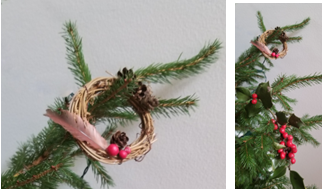
Little wreaths from the craft store were the bases for hemlock cones and acorns, plus a feather for accent. The holly sprigs were, again, from a neighbor's yard on a non-snowy day. 

The wooden "snowflake" came from a craft fair and was handmade using walnut, ash, cherry,  poplar and mahogany. Several were purchased as gifts. On a trip to Japan, students were asked to bring a few small gifts in case they needed to thank someone. A group got lost and a stranger led them back to their hostel. He received one of these in a small, tied box as a thank you. I am sure he was pleased to open the box and see one of these with a note about the wood.


And there is even a few Monarch wings that were found here and there. 

Wishing you a holiday season that brings you happy memories and thoughts of the great celebrations coming in the Aftertime.


Thursday, December 17, 2020

Snow on the Mountain Cookies


Since my son was young we have made these cookies at Christmas time. I hope I will be able to make them with my grandkids next year. They are also known as Chocolate Crinkle Cookies. This is from the back of a Nestle's mint chocolate chip package many years ago.

1 ½ C chocolate morsels- 10 oz. (mint if you can find them) divided
6 Tbsp of softened butter (3/4 stick)
1 C sugar
2 eggs
1 tsp vanilla
1 tsp peppermint extract
1 ½ C flour
1 ½ tsp baking POWDER
1 tsp salt
10 X powdered sugar

Combine flour, baking powder and salt in a bowl.

Melt 1 C of the chocolate chips. In microwave- 1 minute on high. Stir. Heat in 30 sec. increments until melted.

(You can use hand mixer). In a large bowl, cream butter and sugar. Add melted chocolate, vanilla, and peppermint. Mix well. Add eggs last so hot melted chocolate does not “cook” them.

By hand, mix in flour, baking powder and salt. Add in the ½ C of chocolate chips. Mix well.

Wrap in wax paper or plastic wrap and put in freezer for 20 minutes.

Put 10 X sugar in a bowl. Make 1 Tbsp balls of the dough and roll in 10 x sugar. Put on Ungreased cookie sheet or lined with parchment paper.

Bake 8-10 minutes. Leave on cookie sheet to cool. They will seem uncooked when you remove them but will end up chewy when left to cool on the cookie sheet. Sift or sprinkle 10x sugar on warm cookies, if desired.

Makes about 6 dozen small cookies.

Dough can be frozen for later use. Roll into balls and freeze separately on a cookie sheet or pan. Put in a freezer bag once frozen. Roll in 10X sugar after thawing and before baking.

Photo from Amanda's Cookin' (https://amandascookin.com/chocolate-crinkle-cookies/)


Let it Snow. Let it Snow. Let it Snow.


Oh, the weather outside is frightful

But inside is so delightful.

Since there's nowhere we can go

Let it snow, let it snow, let it snow.


Oh, my face mask keeps my cheeks so warm 

As I venture outside in the storm.

The driveway walking goes oh, so slow

Let it snow, let it snow, let it snow.


When I finally get to the mail

There are catalogs with stuff for sale

Just two Christmas greeting cards to show

Let it snow, let it snow, let it snow


Oh, there's chili warming in the pot

We've got a pan of cornbread that's hot

Our glasses are filled with white Merlot

Let it snow, let it snow, let it snow


While the dishes are slowly drying

At last there's time for pumpkin pie-ing

We cuddle up with our favorite show

Let it snow, let it snow, let it snow


As we wander off to go to sleep

Knowing tomorrow's snow will be deep

Our new snowblower is gassed to go

Let it snow, let it snow, let it snow


I Write - The Left Pocket

  At our monthly Writing is Fun meetings we decide on a writing  prompt for the next meeting.    The prompt for November 2026 was Pocket. TH...